
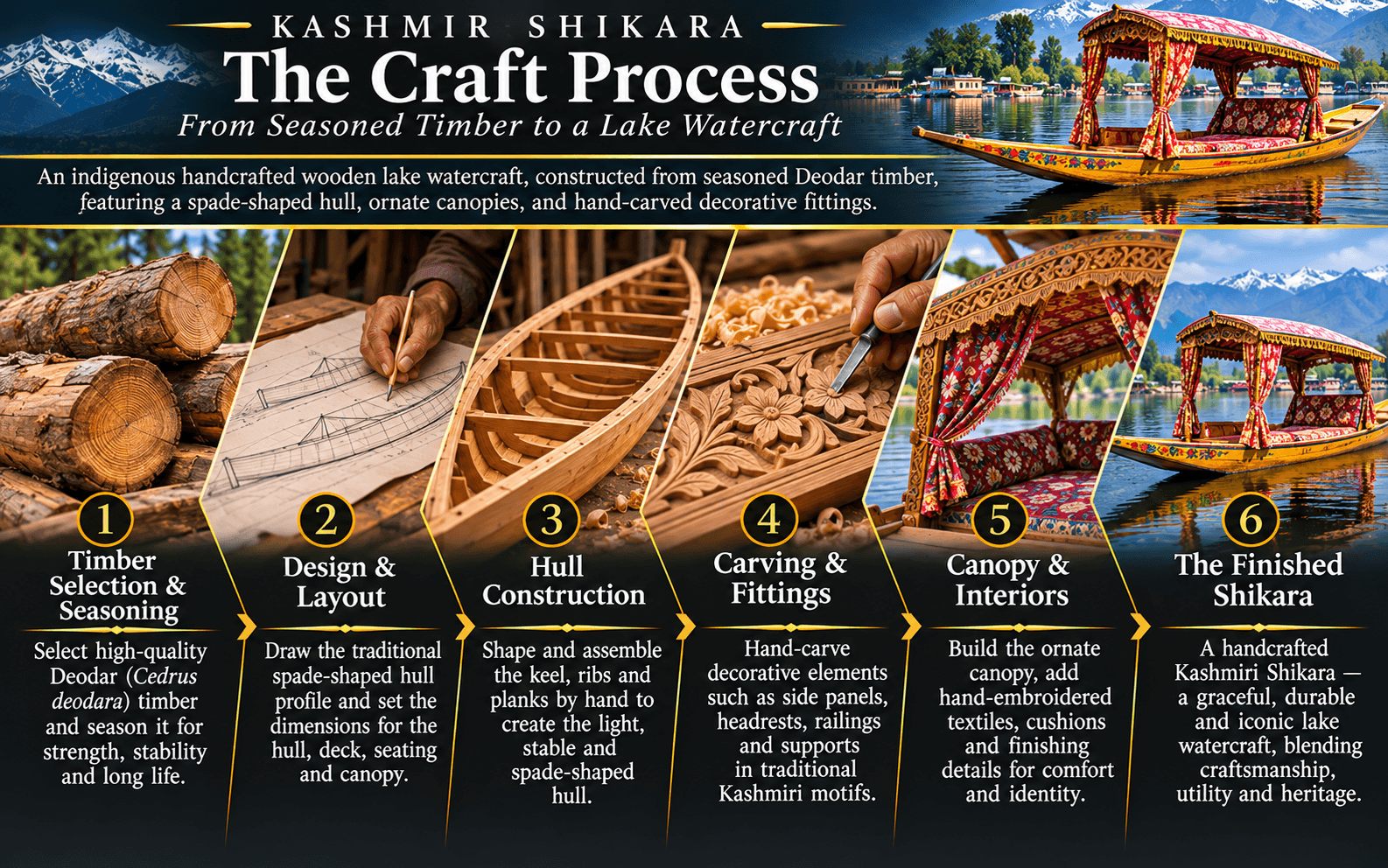
Heritage & Origin of Kashmir Shikara
The Kashmir Shikara is an iconic indigenous wooden watercraft handcrafted from seasoned Himalayan Deodar (Cedrus deodara) timber by hereditary boatwrights (Khangars) along Srinagar’s Dal and Nigeen Lakes, combining traditional marine joinery, Chinar relief woodcarving, and Kashmiri textile upholstery.
Authentic Kashmir Shikara relies on Mature Himalayan Deodar timber (Cedrus deodara), Cold-forged iron & copper rivets, Deodar resin pitch, Crewel & Gabba canopy upholstery (Rot-resistant seasoned Deodar planks scarf-jointed over a flat shallow-draft keel; zero fiberglass or molded plastic hull components.) sourced from Pir Panjal & Himalayan Deodar timber crafted in Rainawari and Dalgate boatyards, Srinagar, executed via Hand-adzed single-length Deodar planking, hereditary geometric hull framing, natural resin caulking, and relief canopy woodcarving..
Protected under GI-870 (Geographical Indications Registry, Government of India (GI Application #870, Certificate #675)) across Dal Lake, Nigeen Lake, and River Jhelum Catchment Basin, Jammu & Kashmir..
700+ Years
Heritage Age
GI Registered
GI Status
Dal Lake & Nigeen Lake, Srinagar
Craft Sector
Verified
Registry Status
Why GI System Matters for Kashmir Shikara
The Craft Geographical Indication System (CGIS) system was designed to address systemic failures in how Kashmir crafts are verified, valued, tracked, and protected. For Kashmir Shikara specifically, these failures have historically resulted in significant economic harm to authentic artisans and confusion among buyers globally.
Counterfeit Market Penetration
While no single statutory census measures global counterfeit share, cooperative field surveys and unverified retail sampling indicate widespread misrepresentation of power-loom and synthetic imitations as authentic Kashmir crafts.
Artisan Income Erosion
Machine-made imitations compress retail price ceilings, forcing genuine handloom weavers and carvers to compete against mechanized unit costs and squeezing real artisan household earnings.
Buyer Information Gap
International buyers frequently lack independent material-testing or GI-registry verification tools and must otherwise rely on unverified seller claims at point of sale.
Heritage Knowledge Loss
Where artisan wages lag behind skilled urban labor, fewer young apprentices enter multi-year hereditary craft training across specialized weave and carving variants.
The CGIS system directly addresses these challenges by providing Kashmir Shikara stakeholders with verified intelligence, transparent methodologies, and publicly accessible data that removes information asymmetry from the market.
CGIS Methodology for Kashmir Shikara
The CGIS system applies a structured, multi-stage intelligence pipeline to Kashmir Shikara. Each stage is independently auditable and produces a verifiable data output that contributes to the overall intelligence record for this craft.
Raw Material Origin Verification
Foundation LayerThe first stage traces raw material provenance back to documented sources in Dal Lake & Nigeen Lake, Srinagar, including supplier documentation, batch records, and geographic origin checks.
Artisan & Cooperative Cross-Reference
Identity LayerParticipating makers and enterprises are cross-referenced against statutory GI Authorized User rolls and the independent Craftlore Trade Registry (CKTRE) where enrolled.
Production Process Audit
Quality LayerThe production methodology for Kashmir Shikara is inspected against documented historical standards. Thread counts, knot densities, dye processes, and finishing techniques are each measured and scored against the GI specification.
Intelligence Output & Scoring
Output LayerAll verified data points are aggregated into a composite intelligence score. This score is attached to the product record, accessible via QR code, and stored in the immutable Craftlore blockchain registry for permanent reference.
Continuous Monitoring & Updates
Monitoring LayerRecords are not static. As new production batches are verified, market data is updated, and risk indicators change, the intelligence record is updated in real time to reflect current conditions.
Key Intelligence Data for Kashmir Shikara
The following data points represent verified intelligence gathered through the CGIS system. Figures marked as estimates will be replaced with verified data as the registry expands. All verified figures are sourced from Craftlore field audits, cooperative records, and cross-referenced government export data.
GI Application
verifiedGI-870
IP India Registry
Registered Artisans
verified350+ estimated master boatwrights (Khangars) & marine woodcarvers
Documented craft practitioners
Active Cooperatives
verifiedThe Wirasat Handicrafts Industrial Cooperative Limited
Audited societies & clusters
Fair Value Corridor
verified₹85,000 – ₹2,60,000 (Full Watercraft · 2025–2026 Srinagar Boatyard Benchmark); ₹3,500 – ₹18,000 (Authentic Scale Deodar Collector Models)
Labor share: 52% of baseline vessel construction cost
Production Duration
verified15 to 30 days of master boatwright and woodcarver labor per vessel
Typical handmade unit cycle
Risk Classification
verifiedHigh
CRVAS vulnerability index
How to Identify Authentic Kashmir Shikara
Authentic Kashmir Shikara has specific physical characteristics, production markers, and documentation requirements that distinguish it from imitations. The following guide is compiled from Craftlore artisan consultations and GI specification documents.
Physical Markers
- Distinctive aromatic seasoned Deodar grain with hand-adzed tool marks along internal ribs
- Hand-forged copper and iron rivet clinches sealed with natural pitch
- Hand-carved Chinar and lattice eaves paired with a single-piece heart-shaped wooden paddle
Laboratory & Forensic Tests
- Cedrus deodara anatomical wood identification
- Hydrostatic hull balance and timber moisture inspection
Red Flags for Counterfeits
- Fiberglass or molded plastic hull shells
- Machine-routed MDF canopy trim
- Unseasoned soft pine substituting for Deodar
Statutory Standards
- Authentic seasoned Himalayan Deodar (Cedrus deodara) timber hull construction
- Traditional spade-shaped pointed bow and flat shallow-water keel geometry
- Zero fiberglass, synthetic resin hull molding, or mechanized hull stamping
Buyer Guide for Kashmir Shikara
Whether you are purchasing Kashmir Shikara for personal use, gifting, or investment, the following guide helps you navigate the market with confidence. Craftlore intelligence systems provide the tools to verify every claim before purchase.
What is a fair price for an authentic Kashmir Shikara?↓
Fair value estimates are calculated by the CAIS Fair Value Engine, which factors in raw material costs, artisan labor hours, skill complexity, and current market rates. Always cross-reference a seller's price against the CAIS market rate before purchasing.
How do I verify the GI status of a Kashmir Shikara product?↓
Statutory GI registration is administered by the Geographical Indications Registry, Government of India. Genuine GI-tagged pieces carry an authorized GI label and serial number, which buyers can cross-check alongside Craftlore CGIS physical verification criteria and Authorized User records.
Where are authentic Kashmir Shikaras made?↓
GI-registered Kashmir Shikaras are produced exclusively in Dal Lake & Nigeen Lake, Srinagar. Products made outside Dal Lake & Nigeen Lake, Srinagar cannot bear the GI designation, regardless of technique or materials used.
How can I find verified Kashmir Shikara sellers?↓
The Craftlore CKTRE Trade Registry lists all verified merchants, cooperatives, and exporters dealing in authentic Kashmir Shikaras. Every entity in the registry has passed a multi-stage identity and compliance verification.
What sustainability credentials should Kashmir Shikaras have?↓
Authentic Kashmir Shikaras can be evaluated via a Craftlore CLEE Environmental Declaration, which quantifies cradle-to-gate product carbon footprints (ISO 14067 & US GHG Protocol), chemical restricted substance compliance (ZDHC MRSL/REACH), and empirical durability.
Frequently Asked Questions — Kashmir Shikara & CGIS
Is the CGIS system free to use?↓
CGIS is a non-commercial, public-interest platform. All intelligence data, verification tools, and registry access are provided free of charge to buyers, researchers, and policymakers.
How are Craftlore intelligence outputs validated?↓
CGIS combines statutory GI technical specifications, published textile/material testing thresholds, and documented field audit protocols. Every metric is labeled as verified, calculated, or an indicative estimate rather than an unexamined commercial claim.
How is CGIS data kept current?↓
Data is updated through continuous field audit cycles, real-time registry integrations, and periodic comprehensive reviews. Critical data points are updated within 24 hours of any change.
Can CGIS data be used in academic research?↓
Yes. CGIS intelligence data is designed to be citable and reproducible. All datasets include methodology documentation, source citations, and version tracking.
How does Craftlore handle disputed records?↓
Any verified entity, artisan, or buyer can raise a formal dispute through the CGIS dispute resolution process. All disputes are reviewed within 7 business days with full audit trails maintained.
Policy & Institutional Context
Kashmir Shikara operates within a complex policy environment involving national GI legislation, international trade agreements, and regional craft development programs. The CGIS system provides policymakers with the verified data needed to make informed decisions about craft sector support.
GI Legislation
Protected under the Geographical Indications of Goods (Registration and Protection) Act, 1999. Registration maintained by the GI Registry of India.
Export Policy
Kashmir Shikara exports are tracked under specific HS codes monitored by the Craftlore CSEME system. Export data informs both artisan welfare policy and trade negotiation positions.
Development Programs
Multiple central and UT craft development initiatives support Kashmiri artisans. Craftlore CLIE provides independent, non-commercial educational modules complementing public artisan welfare programs.