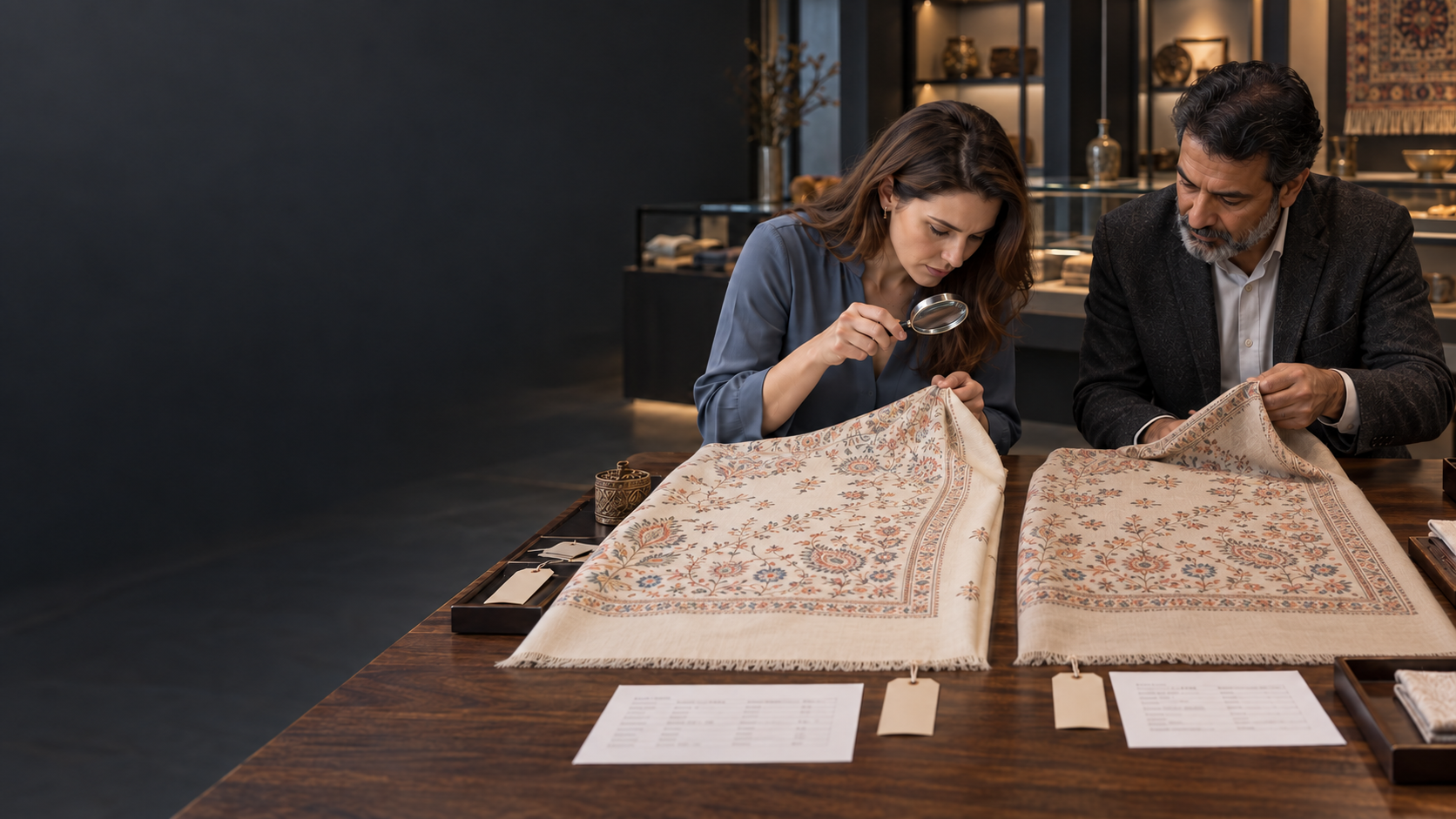
Coordinate GI records, digital passports, seller audits, and pricing baselines. Separate corroborated handmade provenance from unsupported commercial claims.
Craftlore Kashmir Handmade Guardian™ — global anti-counterfeit intelligence and handmade craft protection.Coordinating statutory Geographical Indication verification, digital product passports, trade-registry seller audits, fair-value pricing baselines, dual-mode desktop browser screening (v1.2.2), and 118 institutional protection pathways into one evidence-based standard.
Point-of-sale listing verification, GI tag & KCDP passport cross-checks, seller trade-registry screening, context-aware institutional pathways, and desktop browser protection.
Indigenous handcrafted Himalayan Deodar wooden lake watercraft featuring a spade-shaped hull, carved cedar canopy, and heart-shaped paddle.
Fair Value Range: ₹85,000 – ₹2,60,000 (Full Watercraft · 2025–2026 Srinagar Boatyard Benchmark); ₹3,500 – ₹18,000 (Authentic Scale Deodar Collector Models)
Artisan Labor Share: 52% of baseline vessel construction cost
Authorized Clusters: Rainawari, Dalgate, Mir Bahri (Dal Lake), Nigeen Basin (350+ estimated master boatwrights (Khangars) & marine woodcarvers registered artisans)
Craftlore Kashmir Handmade Guardian™ (CKHG) coordinates statutory GI verification, cryptographic digital passports, trade-registry audits, pricing baselines, and global institutional pathways to challenge deceptive craft commerce.
“Across global e-commerce, industrial power-loom wraps, viscose blends, and machine-printed carpets routinely borrow the vocabulary of Kashmiri master artisans. Buyers are misled at checkout, while living handloom weavers lose livelihoods to unverified claims. CKHG brings coordinated, non-defamatory forensic evidence directly to the point of decision.”
Online shoppers rarely possess scanning electron microscopes or direct access to Geographical Indication registries while browsing product listings. Deceptive sellers exploit this asymmetry by citing generic category numbers such as GI-46, attaching self-issued certificates, or pairing luxury heritage copy with synthetic substrates.
Rather than operating in isolation, CKHG orchestrates Craftlore’s specialized registries—CGIS for item-level GI tags, CPBC for Kashmir Craft Digital Passports, CKTRE for verified entities and sanctions, CAIS for fair-value labor baselines, CDPS for motif rights, and CLEE/CSEME for material and socioeconomic context.
Every CKHG audit separates Product Trust, Seller Trust, and Buyer Guidance under strict evidentiary guardrails. Unregistered artisans are never falsely labeled counterfeit, while verifiable contradictions are structured for informed buyer caution and authorized institutional escalation across 118 global organizations.
CKHG connects point-of-sale browser screening, 8-dimension forensic listing analysis, context-aware pathway investigations, direct registry lookups, global institutional mapping, and structured counterfeit reporting.
Inspect eligible craft product pages on desktop Chromium browsers using dual-mode buyer protection (v1.2.2).
Evaluate any listing across eight forensic checks covering GI serials, provenance, seller standing, and pricing.
Switch between seven institutional pathways to run specialized presets, engine scopes, and checkout previews.
Query CGIS GI serials, CPBC KCDP passports, CKTRE seller profiles, and CAIS baselines directly.
Navigate 118 verified organizations across browsers, marketplaces, IP offices, labs, watchdogs, and payment rails.
Submit structured counterfeit or deceptive-origin evidence dossiers and track personal investigation history.
Eight connected operational tabs inside the dedicated CKHG Dashboard covering forensic listing audits, context-aware institutional pathways, desktop browser protection, registry lookups, and evidence reporting.
Examine product titles, descriptions, retail pricing, GI codes, KCDP passport IDs, and seller names simultaneously across eight forensic dimensions with separate Product Trust, Seller Trust, and Buyer Guidance verdicts.
Dedicated single-purpose lookups for CGIS item GI codes, CPBC Digital Passports, CKTRE verified trade entities, and canonical craft handmade markers.
Selecting an institutional pathway dynamically reconfigures investigation objectives, filtered organizations (118 total), required evidentiary inputs, Craftlore engine execution scopes, and Pathway 07’s live pre-payment checkout preview.
Download the tested Chromium extension (.ZIP), configure Automatic vs. User-Controlled modes, or install the mobile PWA workspace.
Search and filter 118 organizations across 7 categories, inspect full compliance profiles, and transfer any entity into the Adaptive Console.
Submit structured counterfeit or false-GI reports to the live intake endpoint and review authenticated investigation history.
Monitor cross-engine health, configure web investigation preferences, inspect live vs. proposed API endpoint classifications, and submit institutional integration applications.
EVIDENCE-FIRST PROTECTION FOR CONSUMERS, ARTISANS, PLATFORMS & INSTITUTIONS
Select your role to inspect tailored counterfeit risks, required evidentiary inputs, connected Craftlore intelligence engines, and direct operational workflows inside the CKHG Dashboard.
Defend authentic hand-spun and hand-woven work against power-loom jacquard and synthetic impersonation.
Gives living master artisans, spinners, and needlework specialists an inspectable evidence pathway to distinguish genuine handmade labor from industrial imitations misusing Kashmir heritage titles online.
Inspect suspicious online listings claiming handmade Kashmiri origin or artisan authorship.
Submit structured counterfeit or misattribution evidence with listing URLs and photographs.
Run Craft, Heritage & Artisan pathway checks linking CKTRE, CPBC, and CDPS records.
Open the Unified Forensic Analysis tab and enter the suspicious listing title, price, and claims
Reconcile stated GI codes and artisan claims against CGIS, CPBC, and CKTRE source records
Review the 8-dimension forensic scorecard separating corroborated proof from contradictions
Generate a structured counterfeit report in Evidence & Reports for institutional review
Auditable Contradiction & Attribution Dossier documenting handmade markers and challenging deceptive listings.
Protect collective producer credibility, verify cooperative GI serials, and expose unauthorized resellers.
Substantiate export consignments with cross-engine evidence and apply for website verification integration.
Ensure statutory Geographical Indication tags are verified at item level and challenge false GI labeling.
Coordinate craft taxonomy standards, curate authenticity benchmarks, and review systemic counterfeit risks.
Every listing investigated by CKHG is evaluated across eight distinct forensic dimensions and ten coordinated Craftlore capabilities—strictly separating corroborated item-level records from unsupported claims.
Checks submitted product GI codes against available CGIS issuing-source records while distinguishing statutory craft registrations (like GI-46) from item-level serial tags.
Compares product origin and custody claims with documented KCDP passport or registry records; unmatched marketing claims remain transparently unverified.
Cross-references merchants, exporters, and cooperatives in CKTRE and PTS-90 rankings. Unmatched identities are never automatically declared fraudulent.
Displays artisan or workshop attribution strictly when supported by verifiable provenance records; unsupported commercial storytelling does not establish authorship.
Flags severe price deviations below handmade material and labor baselines for buyer diligence without treating low price as standalone proof of counterfeiting.
Detects synthetic fibers, power-loom jacquard, computer embroidery, or CNC terms conflicting with handmade GI claims, alongside attributable CKTRE sanctions.
Reports statutory material reference criteria and connected CLEE environmental parameters only when documented—never fabricating laboratory or carbon metrics.
Provides published craft-sector labor-share and cluster benchmarks where available without claiming unverified wage disbursements on individual listings.
Separates statutory craft GI numbers (such as GI-46) from verified item-level GI product tags.
Examines Kashmir Craft Digital Passport (KCDP) records for active, provisional, or revoked status.
Cross-reconciles stated origin, workshop lineage, and material specifications across source records.
Checks merchant, exporter, and cooperative entities against CKTRE without treating non-enrollment as fraud.
Presents master-artisan or workshop attribution strictly when backed by registered provenance records.
Evaluates hand-loom, hand-knotting, needlework, and joinery claims against mechanized production markers.
Flags severe sub-artisan price anomalies against handmade baselines as diligence prompts, not proof of fraud.
Screens synthetic-fiber and industrial-substrate contradictions against statutory craft specifications.
Screens attributable CKTRE gi_craft_blacklist sanctions and provides structured report intake.
Maps product and seller evidence to browsers, marketplaces, IP offices, labs, heritage bodies, watchdogs, and checkout.
Intake → Scoped Engine Queries → Contradiction Reconciliation → 3-State Evidence Classification → Buyer Guidance & Authorized Escalation.
Captures product title, GI serials, KCDP ID, material claims, price, and seller identity.
Queries CGIS, CPBC, CKTRE, CAIS, CDPS, CSEME, or Checkout Preview per pathway.
Separates category GI numbers from item serials and screens synthetic or machine terms.
Classifies outcomes into Corroborated, Evidence Discrepancy, or Insufficient / Unverified.
Provides pre-purchase diligence steps and verified reporting channels across 118 entities.
Desktop Chromium browser extension (Version 1.2.2) for point-of-sale screening alongside an installable Progressive Web App workspace for mobile and desktop devices.
Point-of-sale counterfeit exposure, GI claim verification, and dual-mode buyer protection on desktop Chromium browsers (Chrome, Edge, Brave, Opera, Vivaldi).
Evidence-backed alerts for eligible craft product-detail pages on user-authorized desktop shopping websites. Zero domains are pre-authorized at installation; users grant and revoke host permissions individually.
Buyer-initiated examination of product authenticity, provenance, GI serials, seller identity, and pricing on demand—running zero background page checks unless explicitly requested.
ckhg-extension.zip → extract archive → open chrome://extensions on a desktop Chromium browser → enable Developer mode → click Load unpacked and select the folder containing manifest.json. Search-result pages, carts, and checkouts are excluded from automatic checks, and Android Chrome does not support desktop extensions (use the installable mobile web workspace below on mobile devices).Install Craftlore Kashmir Handmade Guardian as a dedicated, standalone application on Windows, macOS, Linux, Android, or iOS. Direct installation from craftlore.org with zero platform fees, no third-party store accounts, and distraction-free offline reference capabilities.
Safari iOS / iPadOS · Add to Home Screen
Chrome · Edge · Samsung Internet · Brave · Firefox
Chrome · Microsoft Edge · Brave Desktop
Craftlore provides two distinct tools. A standalone PWA cannot inspect external shopping tabs, while the desktop Manifest V3 extension (Version 1.2.2 Tested Desktop Release) provides User-Controlled Investigation and opt-in Automatic Protection on eligible product-detail pages of individually authorized shopping websites.
| Capability | Standalone App (PWA) | Browser Extension (MV3 · v1.2.2 Desktop) |
|---|---|---|
| Primary Purpose | Deep forensic investigation & direct craft audit workspace | Opt-in detection & investigation on eligible product-detail pages of individually authorized desktop websites |
| Platform & Page Scope | Standalone window (Desktop, iOS & Android) | Desktop Chromium product-detail pages only (search-result pages & Android Chrome are not monitored) |
| Third-Party Shopping Websites | Manual URL entry only (Sandboxed to app) | Requires unpacked installation, explicit per-site permission & Automatic mode enabled |
| Trust Signals & Modes | Direct User Investigation | User-Controlled (default) or opt-in Automatic; reports separate product trust, seller trust & buyer guidance (no Verified Authentic status without product & craftsmanship evidence) |
| Offline Reference Capabilities | Cached taxonomies, GI checkpoints & benchmark formulas | Requires online backend API connection |
| Distribution & Validation Status | Direct install from craftlore.org (Zero fees) | Tested unpacked desktop ZIP (Version 1.2.2 — loaded manually via chrome://extensions; never installed silently) |
Offline reference content, where previously cached by the browser, is not independent product authentication. Current registry checks require an internet connection and an accessible evidence source.
Unified coverage spanning browsers, global marketplaces, GI & IP authorities, standards and testing laboratories, heritage institutions, consumer watchdogs, and 40 checkout & payment providers.
Integrated institutional protection directory and cooperation network spanning 118 global browser runtimes, marketplaces, IP authorities, standards bodies, heritage institutions, consumer watchdogs, and payment networks across 7 categories.
Browser distribution, extension compatibility and mobile access
Product listings, seller integrations and responsible marketplace interoperability
GI evidence, IP protection, enforcement coordination and reporting
Digital identity, accredited testing and product evidence
Craft preservation, cultural documentation and artisan participation
Consumer complaints, dispute pathways and applicable public warnings
Payment processing, checkout verification, merchant integrity and anti-counterfeit protection
Directory Coverage vs. Live Infrastructure Connectivity
CKHG distinguishes five governance layers across all 118 records: (1) CKHG Directory Coverage, (2) Merchant-Side Pre-Checkout Integration, (3) Direct Provider API Connectivity, (4) Institutional Reporting Capability, and (5) Formal Partnership Status.
Directory inclusion, published developer documentation, or public intellectual-property complaint channels never imply direct financial-network access or formal partnership.
Protecting Consumers, Traditional Craft Techniques, Artisans, Authentic Handmade Products, and Checkout Integrity.
Helps buyers screen listings for synthetic-fibre terms, unrealistic prices and GI codes that CGIS does not confirm.
Documents what hand-spinning, hand-weaving and coded talim patterns involve, so that machine-made goods are harder to pass off as handmade.
Supports attribution for weavers, spinners and woodcarvers through CKTRE registration and CPBC passports, where an artisan has recorded them.
Takes counterfeit reports into CKTRE's documented case workflow and checks sellers against CKTRE blacklist records.
Supports consumers and legitimate merchants by making available craft authenticity findings before participating online checkout, and assisting authorized parties with documented anti-counterfeit complaints.
Craft retailers, marketplaces, artisan cooperatives, heritage institutions, browser developers, consumer-protection organizations, and payment/checkout infrastructure providers may apply to integrate CKHG's evidence-based verification capabilities into their authorized digital services.
Proposed verification widget; not currently available
Proposed catalog evidence API; not currently available
Interoperability for third-party shopping companions and browsers
Proposed institutional evidence exchange, subject to agreement
Proposed merchant-authorized pre-payment disclosure; not currently issued
Submit your platform, store, payment service or institution for review. Each recorded application receives a reference number. Submitting does not issue API keys, widgets or credentials.
Institutional credibility demands strict legal and technical boundaries. CKHG enforces six non-negotiable guardrails across every browser alert, forensic check, and checkout preview.
Citing a statutory registration number such as GI-46 identifies the Kashmir Pashmina craft category under Indian law—it never proves an individual shawl is authenticated without an item-level GI tag serial.
Many genuine small-holder artisans and legacy workshops are not yet enrolled in digital registries. Absence from CKTRE or CPBC is classified as Unverified, never as counterfeit.
Prices far below CAIS raw-material and hand-labor baselines trigger a high-priority diligence advisory, while liquidation or distress sales are distinguished from proven imitation.
All 40 payment institutions in Section 7 operate under CKHG protection pathways and merchant-authorized pre-checkout previews; CKHG never accesses raw PAN, CVV, or private banking rails.
The Handmade Guardian™ v1.2.2 desktop extension defaults to User-Controlled mode with zero pre-authorized shopping domains. Automatic screening runs strictly on user-approved product pages.
CKHG assembles structured, source-cited evidentiary dossiers. Formal takedowns, customs holds, and dispute adjudications remain exclusively with authorized platforms, regulators, and courts.
Marketplaces, luxury retail houses, customs brokers, and checkout merchants can test product claims against CKHG’s live pre-payment verification contract (POST /api/ckhg/checkout-verify-preview) or enter the full 8-tab Handmade Guardian Operational Dashboard.
Claims examined. Artisans defended. Counterfeit commerce challenged with verifiable evidence.